What Is a Rally Co-Driver? The Job Behind the Pace Notes
The voice beside a rally driver does far more than call corners. Here is how preparation, pace notes, timing and teamwork fit together.
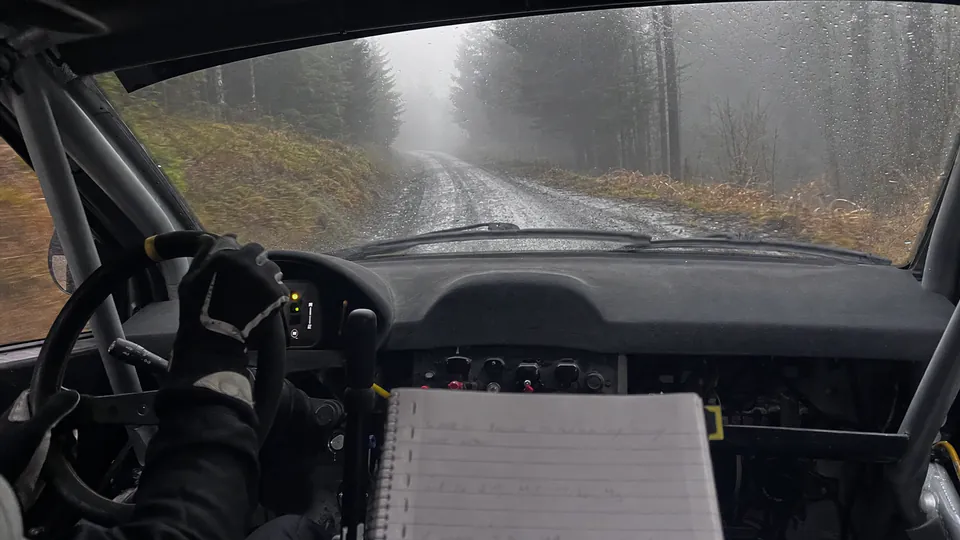
In this article
- What does a rally co-driver actually do?
- Before the rally comes reconnaissance
- What happens during a special stage?
- The job continues between stages
- One rally loop from the co-driver's seat
- What makes a good rally co-driver?
- Co-drivers in rallies, games and road cars
- How can you try the co-driver experience?
- Sources
A rally co-driver is the second member of a rally crew. Sitting beside the driver, the co-driver helps prepare the pace notes, reads the road ahead during competitive stages, navigates the route between stages and keeps the crew on schedule. The voice is the most visible part of the job, but not the whole job.
In the 2026 FIA World Rally Championship regulations, a crew is formally defined as two people: a driver and a co-driver. They compete together, and a mistake with timing or navigation can matter just as much as a missed corner call.
What does a rally co-driver actually do?
The co-driver turns a complicated event into a sequence the driver can act on. Their main tasks usually include:
- preparing, checking or organizing the pace notes;
- delivering those notes at the right moment on a special stage;
- navigating road sections between stages with the event road book;
- calculating due times and managing the time card;
- following changes to the itinerary, bulletins and instructions;
- communicating useful information to the driver and team; and
- helping with permitted work on the car when the event format allows it.
That combination is why “navigator” is only a partial description. Navigation is central, but a stage-rally co-driver is also the crew’s clock, organizer and information manager. Motorsport UK’s beginner guide for stage co-drivers summarizes the role as guiding the driver with notes while assisting with timekeeping and work between stages.
Before the rally comes reconnaissance
On many major stage rallies, the crew studies the route during reconnaissance, commonly shortened to recce. They travel through a stage at controlled speed before competition and build or check the description they will later use at rally pace.
The driver normally describes what they want recorded. The co-driver writes that description in a compact shorthand, then reads it back so both people can correct the detail and rhythm. The result is not a generic script. It is a shared language shaped around what that driver needs to hear.
Procedures vary by championship and event. Under the current WRC rules, checked on 3 August 2026, reconnaissance follows an organizer timetable and each crew is limited to two passes over each special stage. At professional level, the preparation begins even earlier. WRC described co-driver Martijn Wydaeghe reviewing organizer videos, previous footage and maps while preparing for a new rally in its article on how a WRC team prepares.
What happens during a special stage?
Once a competitive stage begins, the co-driver reads the notes aloud through the car’s intercom. Each short call describes a piece of road that may still be out of sight: direction, corner severity, distance, crest, caution or the way one feature connects to the next.
The driver does not need a lecture. They need the next useful piece of information, spoken clearly and early enough to understand, but not so early that it becomes detached from the road. The co-driver therefore has to keep their place in the notes and match the delivery to the crew’s agreed rhythm, even over bumps and through noise.
If you want to decode the vocabulary itself, our guide to rally pace notes explains direction, numbers, modifiers and distances. The important point here is that the co-driver is not improvising instructions from the passenger seat. They are delivering the crew’s prepared description in a form the driver already understands.
The job continues between stages
A rally is not one continuous timed run. Special stages are connected by road sections, where the crew follows the event route and the ordinary traffic rules that apply there. This is when the co-driver switches from rapid pace-note delivery to road-book navigation and schedule management.
The time card records the crew’s progress through controls. Under the 2026 WRC regulations, the crew is responsible for the card, for presenting it at controls and for the accuracy of its entries. The target check-in time is also the crew’s responsibility. Arriving at the wrong moment can bring a penalty, so mental arithmetic and an accurately set watch are genuine competitive tools.
The co-driver may also check amended instructions, direct the driver toward service, report how the stage felt, prepare the next set of notes and make sure both crew members are ready to go again. There is very little empty passenger-seat time.
One rally loop from the co-driver’s seat
The rhythm becomes clearer when the tasks are placed in order:
| Moment | What the co-driver is doing |
|---|---|
| Before the event | Studies regulations, schedules, maps and organizer information |
| During recce | Writes or checks the crew’s pace notes and practises reading them back |
| On the road section | Navigates with the road book and calculates the next due time |
| At the time control | Presents the time card at the correct moment and checks the recorded entry |
| On the special stage | Reads the pace notes in sequence and keeps the delivery aligned with the road |
| After the stage | Navigates onward, updates the team and prepares for the next stage |
The exact paperwork and division of work change across WRC, national events, historic rallies and single-venue competitions. The pattern remains recognizable: prepare, communicate, keep time and keep the crew oriented.
What makes a good rally co-driver?
Clear speech matters, but several less obvious skills hold the role together.
Concentration: The co-driver must read while being shaken, compressed into safety equipment and surrounded by engine, transmission and road noise.
Timing: A correct note at the wrong moment is not a good call. Delivery has to match the driver’s preferred lead time and the density of the road.
Organization: Schedules, route books, time cards, notes and updates all need to be ready before the driver asks for them.
Adaptability: Different drivers use different words, symbols and rhythms. A co-driver learns that language and notices when the crew has fallen out of sync.
Composure: Errors and surprises need a calm response. Panic consumes attention that the next instruction may need.
Motorsport UK’s feature Plight of the Navigator shows how these demands combine. Its co-drivers describe the role as a constant clock and an office manager inside the car, as well as explaining how much practice goes into writing and delivering notes.
Co-drivers in rallies, games and road cars
The same language appears in several settings, but the roles are not interchangeable.
| Setting | What “co-driver” means |
|---|---|
| Competitive stage rally | A licensed human crew member responsible for pace-note delivery, navigation, timing and event tasks under the applicable rules |
| Road or navigational rally | A navigator whose emphasis may be route finding, checkpoints and timekeeping rather than high-speed pace-note delivery |
| Rally game | A recorded or generated voice tied to the game’s prepared stage data, without the human crew’s paperwork and event management |
| Ordinary public-road drive | A passenger or assistance tool may give route or corner information, but the road remains public and normal traffic law always applies |
This distinction matters. Hearing “Right 4” in a game can teach the rhythm of a call, but it does not reproduce recce, time controls, physical load or the trust built by a real crew. Likewise, rally-style callouts on a public road do not make that road a special stage.
How can you try the co-driver experience?
A rally game is the simplest place to learn the sound of pace notes. A local motorsport club can explain the real route into navigation or co-driving, including the licences, training and safety equipment required in your country. Both teach more about the role without first buying and preparing a competition car.
Krace offers another small piece of that experience on Android. It can speak rally-style callouts itself and adjust their timing with the vehicle’s speed. If a passenger wants the human role, the phone can instead be handed to them before setting off. In Co-Driver Mode, the passenger sees a live pace-note feed and reads each call aloud while the app voice stays silent.
That is not a replacement for a trained competition co-driver, and an ordinary road is never a rally stage. Set up the app while parked, keep the phone with the passenger, obey traffic law and drive to the visible conditions. Krace is an assistance and entertainment aid. Its calls can be wrong, late or missing, and the driver remains responsible at all times.
Sources
From the Krace blog
Keep reading
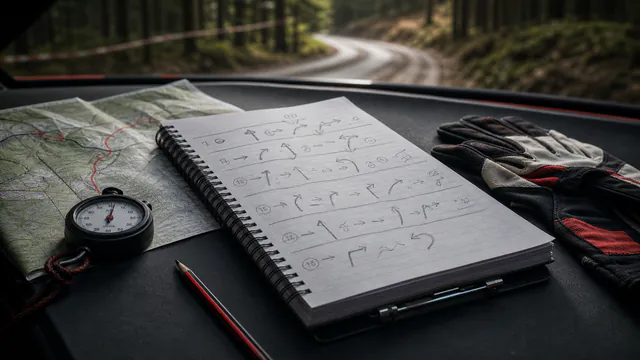
Rally Pace Notes Explained: How to Understand Co-Driver Calls
Pace notes turn the unseen road ahead into a compact spoken language. Here is how direction, numbers, modifiers and distances fit together.
The Best Driving Roads in Germany: 7 Routes Worth the Detour
Seven real driving roads across Germany, chosen for what they are actually like to drive, not for how they photograph.
How to Drive a GPX or Google Maps Route With Rally-Style Callouts
A route from a GPX file or a shared link is not yet a drive. Here is what the format actually contains and how to follow it by ear instead of by screen.