Rally Pace Notes Explained: How to Understand Co-Driver Calls
Pace notes turn the unseen road ahead into a compact spoken language. Here is how direction, numbers, modifiers and distances fit together.
In this article
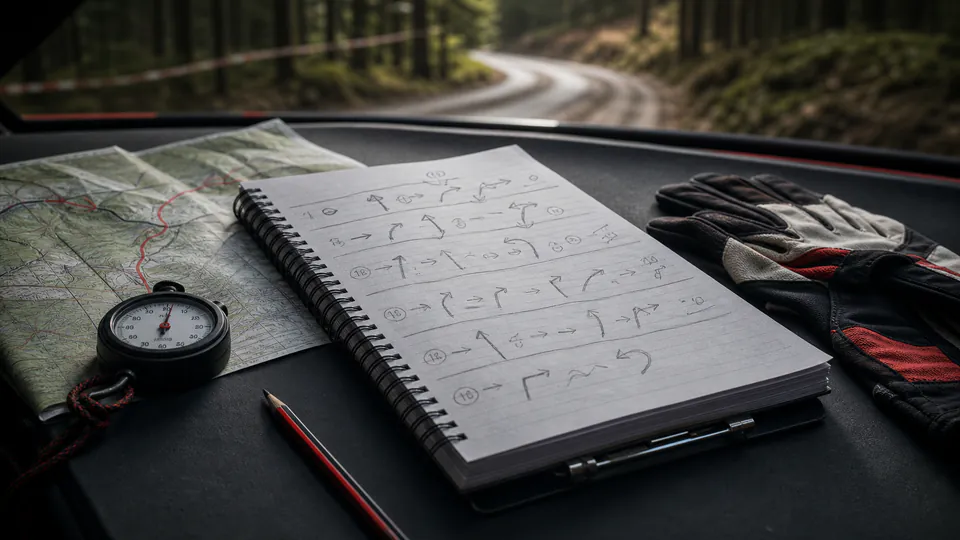
Rally pace notes are a compact description of the road ahead. The driver and co-driver use them to communicate corners, distances, crests and other features before they come into view. A complete call might sound complicated at first, but most calls are assembled from a small set of building blocks.
Take this example:
It describes a moderately tight left corner followed immediately by a more open right corner. The word “into” tells the driver there is no meaningful straight between them. Once you understand how those parts fit together, longer calls become much easier to follow.
What information does a pace note contain?
A pace note can contain five main kinds of information:
- Direction: left or right.
- Severity: how tight or open the corner is.
- Modifiers: how the corner changes or what makes it unusual.
- Distance: how far it is to the next feature.
- Sequence: whether features are linked closely together.
Not every note uses every part. “Right 4” can be enough for a simple corner. A complicated section might need direction, severity, a modifier and the next linked corner.
The official EA SPORTS WRC beginner guide uses the same basic breakdown: number, direction and modifier, with distances and linking terms added where needed.
Direction comes first
The simplest part is the direction of the corner. “Left” means the road turns left and “right” means it turns right. Crews need these calls to be short and unmistakable, so pace notes avoid full sentences.
Different crews may choose a different word order. One crew might say “left three” while another prefers “three left.” The important part is consistency between the person writing the notes, the co-driver reading them and the driver interpreting them.
What do the numbers mean?
In a common 1 to 6 system, a lower number means a tighter corner and a higher number means a more open corner:
| Call | General shape |
|---|---|
| 1 | Very tight |
| 2 | Tight |
| 3 | Moderately tight |
| 4 | Medium or open |
| 5 | Fast and open |
| 6 | Very open, close to straight |
This table is a way to understand the language, not a promise about a safe speed. Surface, weather, visibility, vehicle and the exact shape of the road still matter.
There is no single numbering convention used by every crew. Some systems reverse the scale, some use angles or descriptive words, and individual crews refine their vocabulary over time. That is why the scale must always be understood in the context of the system that produced it.
Krace supports a numerical 1 to 6 mode as well as a simpler Easy, Medium and Hard mode. The underlying purpose is the same: give the next corner a severity label that can be understood before the corner arrives.
Modifiers explain the shape
A single number cannot describe everything a corner does. Modifiers add the detail that makes a basic call more useful.
Common examples include:
- Tightens: the corner becomes tighter as it continues.
- Opens: the corner becomes less tight toward the exit.
- Long: the corner continues for longer than expected.
- Short: the corner finishes quickly.
- Over crest: the road rises and the view beyond it may be limited.
- Don’t cut: keep away from the inside of the corner.
For example, “right four tightens three” begins as a more open right corner and becomes tighter. The second number describes the later part of the same corner rather than a separate turn.
Distances control the rhythm
Distance calls describe the gap to the next feature, commonly in metres. “One hundred” means there is roughly 100 metres before the next instruction becomes relevant. Distances help the driver separate one group of information from the next.
Short linking words handle the opposite situation:
- Into: the next feature follows immediately.
- And: the features are close, but have slightly more separation.
- Then: the next feature follows in sequence with a clearer gap.
The exact vocabulary again depends on the system. What matters is that the timing and wording make the structure of the road understandable.
How are rally pace notes created?
In competition, crews prepare notes during reconnaissance, usually called recce. They travel the stage before competition and build a description that matches the driver’s preferences. The co-driver records that description, checks it and later reads it back during the stage.
Reconnaissance is a formally regulated part of modern WRC events, documented in the current FIA WRC regulations. Its importance is also clear in first-hand driver accounts. In an FIA Rally Japan interview, Heikki Kovalainen described creating good notes and understanding the co-driver’s reading as one of the central challenges of moving into rally.
Professional notes are therefore not merely copied from a universal dictionary. They are a shared language refined by a particular crew.
Why call timing matters
Even a correct call is difficult to use if it arrives at the wrong moment. Too early, and the driver may connect it to the wrong corner. Too late, and the information no longer describes the road ahead.
Human co-drivers adjust their delivery to the pace and complexity of the stage. Rally games expose similar earlier or later timing settings. Krace approaches the same communication problem by retiming callouts against the speed at which the vehicle is actually moving.
The goal is not to replace observation. It is to keep the spoken sequence connected to the upcoming road as the timing changes.
A simple way to practise listening
When learning, avoid trying to remember every modifier at once. Build up in layers:
- Listen only for left and right.
- Add the severity number or descriptive level.
- Add “into” and the distance calls.
- Introduce modifiers such as “tightens” and “opens.”
- Practise short sequences until they form one mental picture.
Rally games are a convenient place to hear repeated calls in a controlled setting. The simplified option described by EA SPORTS WRC is also useful when a full numerical system creates too much information at once.
What pace notes do not tell you
Pace notes are a description, not a guarantee. They cannot remove uncertainty from changing grip, traffic, weather, temporary hazards or an inaccurate road model. A missed, late or incorrect call must never override what the driver can actually see.
On public roads, the real road, traffic law, visibility and conditions always come first. Krace is an assistance and entertainment aid. Its callouts can be wrong, late or missing, and the driver remains responsible for the vehicle at all times.
The complete call, decoded
Return to the first example:
- Left gives the first direction.
- 3 gives the first corner’s severity.
- Into says the next corner follows immediately.
- Right changes direction.
- 4 describes a more open second corner.
That small sentence carries a structured picture of two linked bends. Longer pace notes use the same principle: a limited vocabulary, arranged consistently, delivered at the moment it becomes useful.
Sources
From the Krace blog
Keep reading
What Is a Rally Co-Driver? The Job Behind the Pace Notes
The voice beside a rally driver does far more than call corners. Here is how preparation, pace notes, timing and teamwork fit together.
The Best Driving Roads in Germany: 7 Routes Worth the Detour
Seven real driving roads across Germany, chosen for what they are actually like to drive, not for how they photograph.
How to Drive a GPX or Google Maps Route With Rally-Style Callouts
A route from a GPX file or a shared link is not yet a drive. Here is what the format actually contains and how to follow it by ear instead of by screen.